
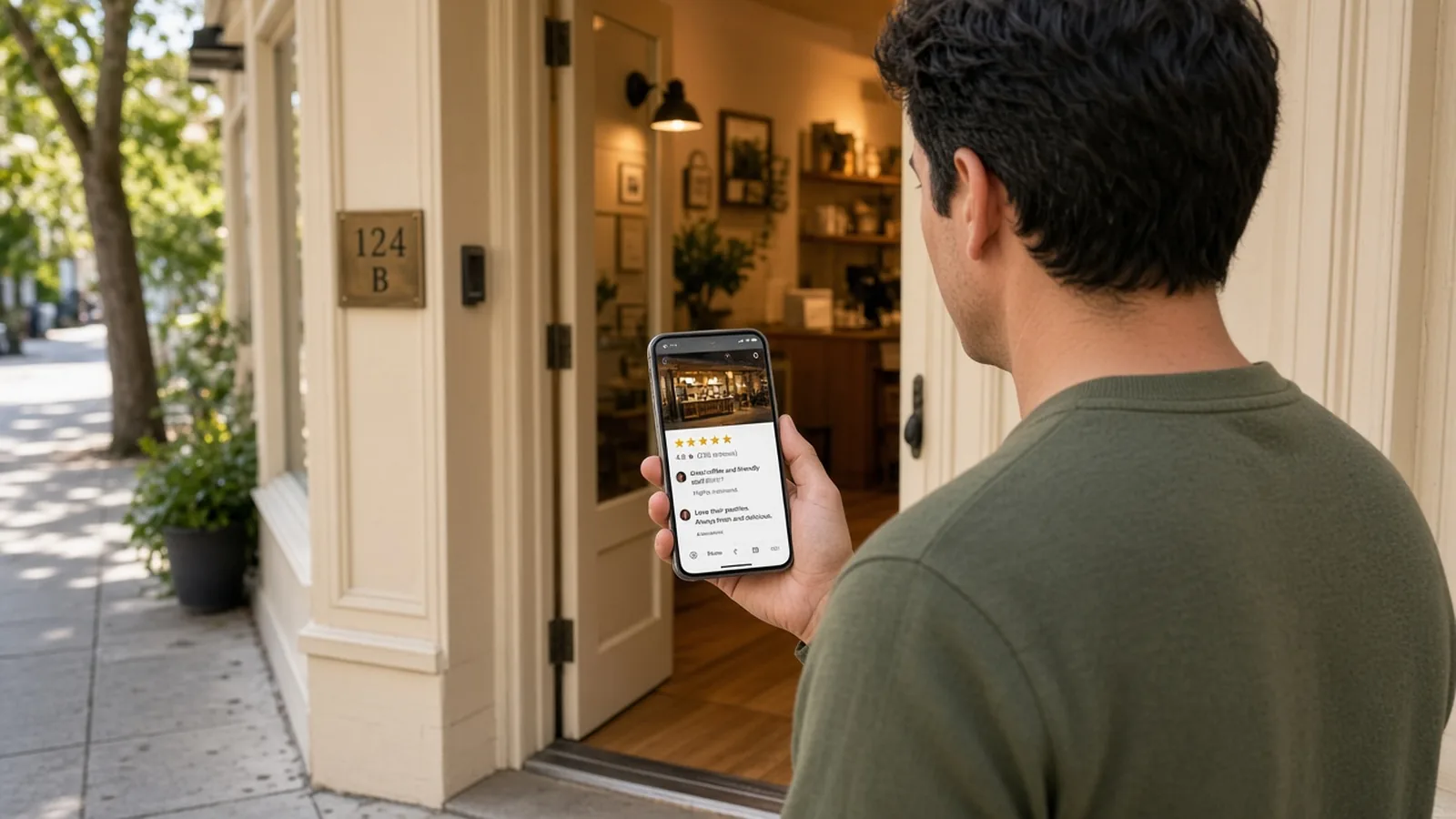
Would you hire you based on what's on the homepage? Be honest. We will wait.
You can have a clean site and a clever line and still lose the room. People do not buy the story until they believe the person telling it. They have been burned. They have a group chat. They have opinions.
Think about the last time you picked a dentist, a contractor, or a software tool. You did not take the tagline at face value. You scanned the stars. You looked for a name you recognized. You wondered why the photos looked like a different company than the reviews — like the website borrowed someone else's weekend.
Credibility is how much trust your brand earns before a prospect ever talks to you. Do proof points, reputation, and presence build confidence — or make someone quietly open a second option?
Visibility without credibility just shows more people a story they do not yet believe. Messaging without proof sounds like a claim your cousin could have written. This pillar is what lets the others work harder.
How It Helps a Brand
When trust signals are real and easy to find, people arrive already inclined to believe you. The conversation shifts from "can they do this?" to "how do we start?" That is a much better conversation. Shorter, too.
That is not a soft metric anymore:
- Edelman, 2025: 80% of people trust the brands they use — more than they trust business, media, government, or NGOs as institutions
- Trust now equals price and quality as a reason to buy
- BrightLocal, 2026 (1,002 U.S. adults): 97% still read reviews when they choose a local business
- 41% now say they always read them, up from 29% the year before
- After a positive review, 85% are more likely to use the business — and 54% then go look at the website
Read that last number again. Half of the people you just convinced with proof will walk through your front door next. If the site does not carry the same confidence — if it still looks like a template with a stock handshake — the trust leaks out on the welcome mat.
Where does your proof sit today?
- A testimonial on a page nobody visits (we have all built that page)
- Five-star work that never made it onto Google because asking felt awkward
- Before-and-afters still on your phone, between a grocery list and a blurry dog
- A "clients" logo row that stopped in 2019 and now feels like a time capsule
Proof has to show up at the moment of hesitation — not buried. Testimonials, results, press, and a consistent look all count. Third-party signals (awards, press, named outcomes) carry extra weight because you cannot invent them in a tagline at 11 p.m.
Early on, building those signals means every future touchpoint starts ahead of zero. As you grow, they need maintenance. The review that won your first customers may not convince the next tier. (The "we survived 2020" line has a shelf life.)
When Proof Is Missing
- Strong traffic, low close rate — people like the story and still do not trust the bet
- Testimonials exist but sit at the bottom of an unused page
- Visuals, reviews, and claims do not match, so the brand feels unfinished
- You have results and never say them in a way a buyer can check
The highest-leverage move is usually placement: your three strongest proof points where the decision actually happens. Not in a PDF. Not "happy to send case studies." On the page. In the room.
In the WunderBrand Score™
Credibility is the fourth pillar. Pulse will name it when the biggest gap is trust, not awareness. Snapshot™ writes the pillar out if you want to see how the proof is — or is not — doing its job.
Previous: Visibility. Next: Conversion: How Attention Becomes Action. Series start: the WunderBrand Score™.